

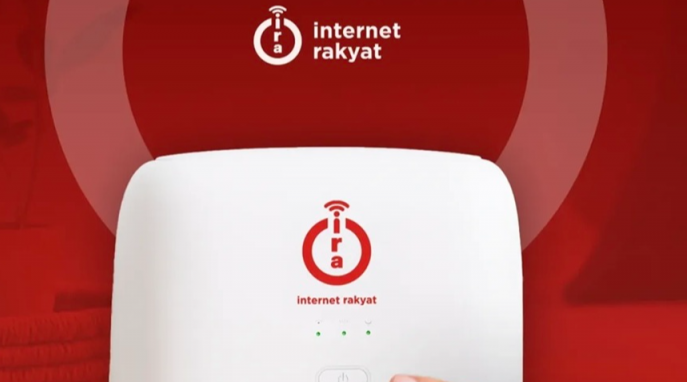
Finally, there is good news from the world of Indonesian technology: Internet Rakyat 100 thousand
Hello, friends,
Usually when I read technology news in Indonesia, the content makes me frown:
The internet is expensive, the signal is uneven, there are frequent disruptions to “unlimited” packages but FUP is everywhere, to the point that reports say our internet prices are among the most expensive in Southeast Asia.Facts
Suddenly, this week, some interesting news has emerged:
People's Internet – 100 Mbps WiFi, unlimited, only Rp100,000 per month.
This isn't a meme, nor is it the wishful thinking of netizens.
This is truly a service that is being seriously developed: a program. People's Internet 5G Fixed Wireless Access (FWA) offered by PT Telemedia Komunikasi Pratama (a subsidiary of PT Solusi Sinergi Digital Tbk / WIFI).Bloomberg Technoz
In this post, I want to have a casual chat about:
- What exactly is this People's Internet?,
- Why is this news? large for ordinary people,
- Why do we still need to be enthusiastic? plus realistic.
Table of Contents
What exactly is this 100 Mbps Internet Rakyat for Rp100,000?
The simple version is this:
- Program name: People's Internet
- Package price: $7.50 / 30 days
- Speed claim: up to 100 Mbps
- Quota: unlimited (no quota limit / no FUP)
- Technology: 5G Fixed Wireless Access (FWA) at a frequency of 1.4 GHz with an approach Open RAN (Basically, it's like Starlink because it doesn't use cables but uses a SIM card instead of satellites, so it's like a mini Starlink, lol.)
- Bonus: free installation, free modem (CPE) rental, and in many cases, the first month is free for new users.
The main target:
- household,
- students,
- WFH workers,
- MSMEs,
- and areas that have been difficult to reach with fiber optic cables.
Currently, the new service is available in some areas. Java, Maluku, and Papua, with a pre-registration system via the official websites internetrakyat.id or mytelemedia.id.
If a 100 Mbps home WiFi connection usually costs between 300,000 and 500,000 rupiah per month, this package is indeed very cheap in terms of price, but is the signal stable?.
Why does this sound “too good”?
First, let's look at the context.
Data cited by many media outlets shows: Before the advent of Internet Rakyat, Indonesia's fixed broadband internet costs per Mbps were among the most expensive in ASEAN.
What does that mean?
- Many families have to spend 300,000–500,000 per month for home internet only.
- Outside of big cities, sometimes even:
- there isn't any home WiFi options,
- or if there is, the quality is “just okay, you know.”.
Then suddenly a package appeared:
100 Mbps, unlimited, IDR 100,000.
It's natural that many people's first reaction is:
“Seriously? In Indonesia? It's not a prank?”
Several reasons why this is very important:
- Access to education
Students who have been relying solely on mobile tethering can now enjoy stable, affordable, and fast internet access. DetikEdu even specifically highlights this package as an affordable solution for students. - Job opportunities & WFH
Remote workers, freelancers, and content creators in small towns now have more opportunities. Connectivity is no longer as big an obstacle as it used to be. - A new lease of life for MSMEs and local creators
Uploading product photos, live sales, video call meetings, and even market research have all become more realistic and less expensive. - Reducing the “digital gap”
This program has not yet reached all regions, but if it is implemented seriously, gap The gap between big cities and the suburbs can gradually be narrowed. The government and Komdigi are also promoting this concept as a way to make high-speed internet more evenly distributed and affordable.
How can it be so cheap? Behind the scenes of Internet Rakyat
There are several key factors behind the People's Internet:
- 5G FWA (Fixed Wireless Access) Technology
Instead of pulling fiber optic cables to every home (which is expensive and time-consuming), Internet Rakyat uses 5G FWA: home internet via a dedicated 5G radio network, which can cover a wide area without having to dig up the ground to lay cables. - Use of the 1.4 GHz frequency
Telemedia won the auction for the 1.4 GHz frequency in several regions, and this frequency is projected to provide low-cost 100 Mbps internet for Rp100,000. - Open RAN + global collaboration
They use an approach Open Radio Access Network (Open RAN) and collaborated with Japanese companies through Orex SAI (NTT Docomo & NEC) to build the infrastructure. That is one of the reasons why this program is often referred to as the world's first commercial network to combine this technology at that frequency.
Meaning:
they are trying to reduce infrastructure costs from the bottom, so that consumer prices can be kept as low as possible.
Behind the euphoria: things we need to be aware of too
Although this is very good news, there are a few points that I think are important to keep expectations realistic.
“Up to 100 Mbps” ≠ always 100 Mbps
Like other internet providers, the numbers in brochures are usually “up to X Mbps,” not a promise that it will always be that fast. This is an annoying marketing trick:
- can go down due to congestion (traffic jam but on the network),
- signal quality,
- modem position,
- the number of users in one area, etc.
So don't be surprised if the numbers fluctuate in real life. It's not magic, but still regular radio and networks.
Coverage is still limited
Currently, the scope is:
- new in several areas in Java, Maluku, and Papua,
- You still need to check each address via their website (there is a coverage check and pre-registration feature). But it uses a signal, right? Oh yes, the BTS is corrupt.
So we can't just shout, “All of Indonesia is now 100 percent internet independent!”
This is just the first step — but a step that deserves appreciation.
New program = there will definitely be “teething problems” at the beginning
Since it is still new, it is very possible:
- The website is slow or down when many people register.,
- Customer service is overwhelmed.,
- out of stock,
- the signal is still unstable in some areas,
- or there is confusion about the requirements and procedures.
This is not an excuse for poor service, but rather a reminder:
we are watching version 1.0 from something ambitious.
If you want to criticize, that's fine. But please keep it factual and professional.
What does this mean for us, ordinary people whose lives are glued to the internet?
If this program really works, is expanded, and its quality is maintained, the possibilities are endless. It's okay to be a little imaginative.
- Students in the suburbs You can take online classes or international courses without worrying about exceeding your data limit.
- Designers, editors, developers, illustrators In a small town, you can work remotely for national/international clients with a decent internet connection.
- Local MSMEs You can sell live every day, upload HD catalogs, create content, without having to constantly worry about your data allowance.
- Ordinary houses You can enjoy legal entertainment (streaming, online games, etc.) without having to hack into your family's cell phone hotspot.
And for people like us who live in the creative/digital world, cheap internet isn't just about watching YouTube more smoothly, but:
the opportunity to participate in the digital economy, not just be a spectator.
Don't stop at gimmicks and headlines
The news about the 100 Mbps Internet Rakyat for Rp100,000 has made many of us small smile in front of the screen.
Finally, there is technology news that truly seems to favor the people, not just investors or users in big cities.
But there is still a lot of work to be done:
- The government must be consistent in simplifying regulations and infrastructure.
- Providers must be transparent about quality, coverage area, and long-term commitment.
- We as users also need to be critical:
- report any problems,
- give honest testimonials,
- and don't just follow the crowd without reading the details.
In the past, we had a story called “electricity comes to the village.”,
Perhaps in a few years we can tell the next generation:
“In the past, paying 100,000 rupiah a month for 100 Mbps WiFi was just a dream.
Now it's become the norm, and that's where many people's lives are slowly changing.”
And if all goes well, this may be one of those rare moments when the phrase:
“Finally, there is good news about technology in Indonesia.”
It's not just a clickbait headline — it's something we can actually experience in our own homes.
Those who wish to register can go to https://internetrakyat.id/