

Understanding AI Agents: When the Brain, Hands, and Nervous System Work Together

Mengenal AI Agent: Ketika Otak, Tangan, dan Sistem Saraf Bekerja Bersama - Ryan Pratama
Select Language

This post is a continuation of Introduction to Agents , the second discussion after From Predictive AI to AI Agents: When Machines No Longer Just Answer Questions About the new way of understanding AI Agents: no longer just smart models, but “creatures made of software” with brains, hands, nervous systems, and bodies that work in a loop to achieve goals.


In my previous article, I discussed the shift from AI that simply “asks → answers → finishes” to systems that can begin to be given mission, make plans, and execute several steps yourself. That is what is referred to as a shift from predictive artificial intelligence to autonomous agents.

Now, let's take a step further:
Actually, what exactly is an “AI Agent”?
And why do people who are serious about this need to break it down into:

  • Model = brain
  • Tools = hands
  • Orchestration Layer = nervous system
  • Deployment = body

So that I'm not just repeating terms, I'll try to explain slowly, using language that even non-hardcore developers can understand.


A small disclaimer before we begin

The discussion I have written here is purely for the purpose of mutual understanding. I have tried to translate and summarize the material as accurately as possible from the whitepaper “Introduction to Agents and Agent Architectures

Still, there may be parts of the translation or explanation that are inaccurate.

If you find any errors, explanations that seem odd, or have a different perspective, I am very open to discussion. Please share your thoughts in the comments section so that we can learn and correct things together.


Why Use the Term “Agent” Instead of Just “AI”?

If we just say “AI,” that's too broad. It could mean:

  • language models (such as ChatGPT, Gemini, etc.),
  • recommendation system,
  • image detection,
  • down to the smallest features on a cell phone camera.

In white paper here, they propose the term AI Agent to describe something more specific:

A system that combines models, tools, orchestration, and deployment, which uses language models within loop to achieve a goal.

So the difference is:

  • Regular AI → often just a model + a single inference.
  • AI agent → complete package: brain, body, hands, nervous system, and lifestyle (loop) that enable it to complete missions, not just answer questions.

If we compare it to a human being, an agent is not just a “brain.” It has a body, hands, nerves, and a way of moving in the world.


Brief Definition: What is an AI Agent?

Simplified from white paper, An AI agent can be defined as follows:

A combination of language models, tools, orchestration layers (“Nervous System”), and runtime services that run models in loops to achieve a goal.

The four main components:

  1. Model (The Brain)
    the part that “thinks,” understands instructions, makes plans, and formulates responses.
  2. Tools (The Hands)
    how agents interact with the real world: calling APIs, reading and writing databases, executing code, sending emails, etc.
  3. Orchestration Layer (The Nervous System)
    which regulates the flow: when to think, when to use tools, how to combine the results, and when to repeat.
  4. Deployment (The Body & Legs)
    Agent “residence”: servers, services, integrations, logging, security, and other aspects that make it accessible to users and other systems.

This combination makes the agent feel more alive because of these four components, not just the model.

In that model, it displays or demonstrates knowledge (data). Let's make sure we understand it correctly, okay?

If you understand the definition of a model: Showcasing or demonstrating products (clothing).

Why am I explaining this? Because there will be many words like "Model" without any AI behind them.


Model: The Brain That Processes Language and Makes Plans

Let's start with the part you hear most often: language model.

This is:

  • component that reads the prompt,
  • understanding the meaning,
  • connecting contexts,
  • then generates text, code, or further instructions.

In the context of agents, model this acts as brain which:

  • deciding what steps make sense,
  • choosing which tools need to be called,
  • interpreting tool results,
  • and put it all together into a complete response.

White paper emphasizing that choosing a model is not just a matter of “the largest size” or “the most sophisticated,” but rather a matter of balance between:

  • reasoning ability,
  • costs,
  • speed,
  • and suitability for specific tasks (coding? business documents? conversations?).

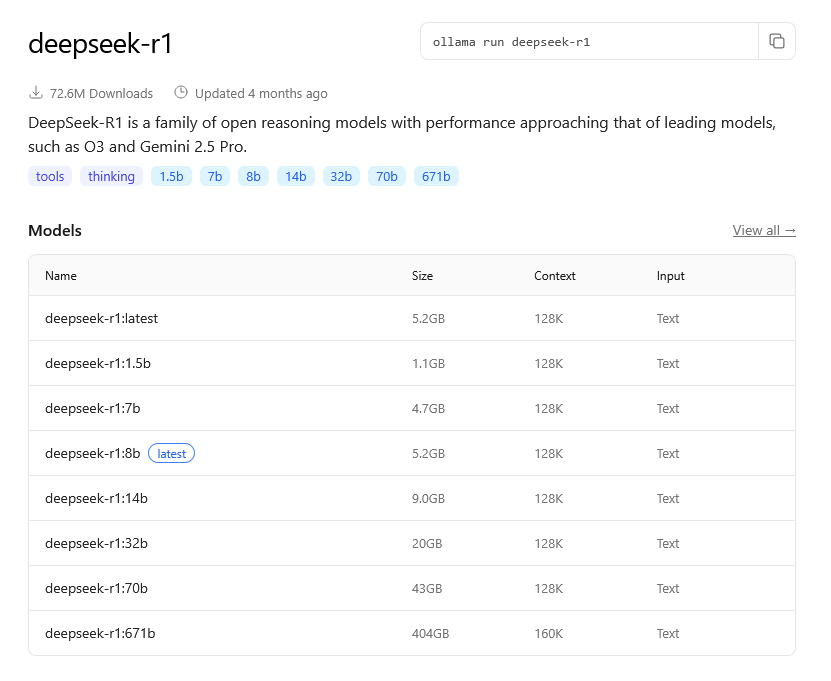
(See the image below to understand what this means.)
Mengenal AI Agent: Ketika Otak, Tangan, dan Sistem Saraf Bekerja Bersama - Ryan Pratama

https://ollama.com/library/deepseek-r1


This image shows the AI data model for Deepseek-r1, where there is code behind its name deepseek-r1:5b-617b (the code behind it indicates how much data is used)

Sometimes, agent architecture actually uses more than one model:

  • a heavy model for planning,
  • several lighter models for small tasks (classification, extraction, etc.).

Tools: Hands That Touch the Real World

A model without tools is like a genius brain locked in an empty room.

Tools is the agent's method:

  • seeing the world beyond the training data, and
  • change something in the real world.

Examples of tools:

  • Retrieval / RAGSearching for documents in a knowledge base, vector store, or search engine. (For example, if you use ChatGPT, you can upload files and search for data on the internet using this tool).
  • NL2SQL: converting natural language questions into SQL queries for databases. (Providing a prompt that will be translated into programming language, for example, “create a minimalist blog header for me”)
  • Business API: check inventory, update order status, send invoices. (A simple example: if you've ever seen an N8N connected to a database and checked inventory via chat, you need this API tool.)
  • Code execution: writing and executing Python/SQL code for data calculations or transformations. (For example, if you've ever asked a math question like 1+1=2, you need this tool.)

Here, agents have the ability to:

  • “seeing” information that is not in the head (in the model),
  • and act through the API, not just talking.

These tools are what make agents worthy of being called “hand”. Without tools, he is just a commentator. With tools, he can become an operator.


Orchestration Layer: The Nervous System That Controls All Movement

Now for the part that is often overlooked but very important: orchestration layer.

If the model is the brain and the tools are the hands, then the orchestration layer is the nervous system which:

  • regulate when the brain should think,
  • when the hand moves,
  • how to remember what just happened,
  • and when to stop.

The orchestration task is roughly as follows:

  • Running a loop Think → Act → Observe repeatedly.
  • Maintaining state / short-term memory:
    • what tools have been called,
    • what is the result?,
    • What is the sequence of steps?.
  • Deciding whether it is necessary:
    • calling a new tool,
    • ask the user,
    • or complete the task.

Here, old prompt engineering develop into context engineering:

  • not just putting together a good prompt,
  • but arranging full context for each step:
    • system instructions,
    • conversation history,
    • previous tool results,
    • data from RAG,
    • user profile, etc.

The orchestration layer makes agents feel like systems that life above the model, not just “one call and it's done.”.


Deployment: The Body That Brings Agents to the Real World

A good agent on a developer's laptop is useless if:

  • inaccessible to users,
  • no logging,
  • unsafe,
  • and cannot bear the load.

Therefore, white paper enter deployment & services as one of the core elements of an agent:

  • where the agent is hosted (cloud, container, dedicated platform),
  • how sessions/history are stored,
  • how logs and traces are recorded,
  • how data security and privacy are maintained,
  • how the scale is set (from prototype to production).

This part may sound “less sexy,” but this is precisely where the agent transforms from an experiment into truly useful services and can be used.

If we were to compare it:

  • model = brain,
  • tools = hands,
  • orchestration = nervous system,
  • deployment = a body that walks in the real world and interact with the environment.

Developer: From Coder to “Director”

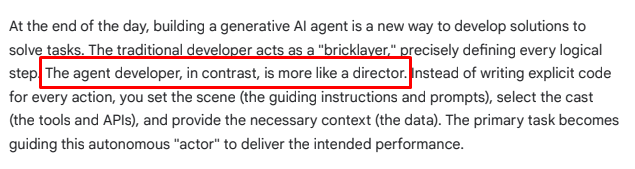
There is an interesting analogy in white paper which I think adequately describes the new role of developers in the world of agents:
Mengenal AI Agent: Ketika Otak, Tangan, dan Sistem Saraf Bekerja Bersama - Ryan Pratama

In the past, developers were like masons who built logic line by line.
Nowadays, developers are more like directors.

What does that mean?

Current developer:

  • no longer writing all the steps explicitly (“if A, then do B, otherwise C...”),
  • but more:
    • design rules & restrictions,
    • choosing player (models, tools, data),
    • compiling context & persona,
    • and observe how the agent acts, then improve it.

It's something like this:

  • Former developer:
    • “If the user clicks the X button, call this function, validate this, save it to this table.”
  • Developer now (in the context of an agent):
    • “You are a support agent for our products.
      This is the guidance document, these are the tools you can use, these are case examples, these are security restrictions.
      Your job: solve user problems according to the rules, and if in doubt, ask.”

Of course, the code remains. The framework remains important. But the focus has shifted from detailed logic coding, to curating the context and environment in which the agent will operate.


Examples of Agents for the Working World

Imagine you have a special agent for:

“Helping manage all your brand's blog and social media content needs.”

With the concept of brain–hand–nervous system–body, it looks something like this:

  • Model (Brain):
    • understanding brand tone,
    • know the style of language,
    • can compose ideas and captions.
  • Tools (Hand):
    • linked to the content calendar,
    • can read the performance of old posts,
    • can write drafts in Notion/Google Docs,
    • even update the status in the CMS (if permitted).
  • Orchestration (Nervous System):
    • maintaining the context of the ongoing campaign,
    • know that today the priority is content X,
    • memutuskan urutan: cek kalender → data → buat draft → simpan → lapor ke kamu.
  • Deployment (Body):
    • running on the server,
    • has a simple UI or chat interface,
    • has logging (so you can check what he has done).

You no longer just ask:

“Please create a caption for product A.”

But more like:

“Please update next week's content calendar for product A's campaign, using last week's performance data as a reference. Create a draft and send me a summary.”


Closing: Agents Are a New Way of Looking at Software

From the section “Introduction to AI Agents,” there is one idea that is repeated throughout:

Agents are not just “smarter AI,” but a new way of building software:
LMs in a loop, with interconnected tools, orchestration, and deployment.

By dividing it into:

  • brain (model),
  • hands (tools),
  • nervous system (orchestration),
  • and body (deployment),

we now have a clearer language for:

  • designing,
  • discuss,
  • and improve these systems.

In the next article, we will begin to delve into How agents solve problems through the “Think – Act – Observe” loop”, and how that process distinguishes it from AI that only responds once.

For now, I would like to conclude with one simple sentence:

The more complex technology becomes, the more important it is to have a simple way of explaining it — not so that we can join the hype, but so that we can maintain control over how we use technology in our lives and work.

Previous Article

Increasing website traffic, when the numbers in analytics are no longer just numbers

Next Article

Internet Rakyat 100 thousand, finally there is good news from the world of Indonesian technology

Write a Comment

Leave a Comment

Your email address will not be published. Required fields are marked *